“Think of your midpoint as the moment halfway through your story when everything changes. It's a crucial turning point that launches your protagonist in a completely new direction. It also keeps your act 2 from sagging, kind of like a trampoline bounce that propels your story into its second half with fresh momentum.”

You asked for it, so here it is: everything you need to know about midpoints without making your brain hurt.
What is a midpoint?
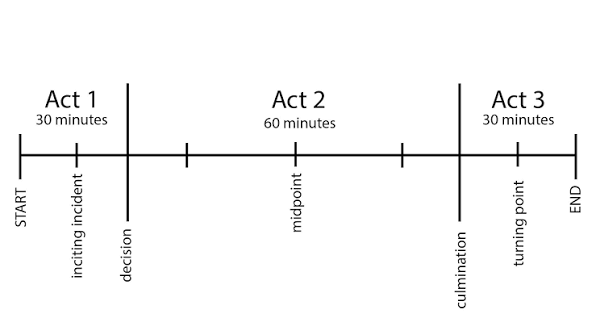
Think of your midpoint as the moment halfway through your story when everything changes. It's a crucial turning point that launches your protagonist in a completely new direction. It also keeps your act 2 from sagging, kind of like a trampoline bounce that propels your story into its second half with fresh momentum.
When does it happen? Around the middle of your story, of course. In a feature screenplay, that's usually page 50-60. In TV, it depends on your structure, but generally it’s the act break of your middle-most act. But we'll get to that later.
The Shift to action: Often, at the midpoint, your protagonist stops reacting to the events following the inciting incident and starts actively pursuing their goal. They’re on offense now.
The three qualities of a strong midpoint
Your midpoint should tick these boxes:
⚡ It relates directly to your main story question (not a subplot)
⚡ It feels like either a clear victory, defeat, or redirection for your protagonist
⚡ It’s powerful enough to change how your protagonist behaves going forward
What kinds of midpoints are there?
False victory
Your protagonist gets what they think they want... and then everything gets worse. Their success is actually empty, or multiplies their problems.
In Miss Congeniality, they find a suspect for their case, which feels like a huge win, but later we learn they got the wrong guy and the real culprit was under their nose the whole time. Gracie does some investigating on her own, not sold on the suspect they have.
False defeat
A major setback or crisis forces your protagonist to abandon their old method of achieving their goal. Things look bleak, but they can bounce back with a new strategy.
In Bring it On, the Toros learn their choreographer, Sparky, sold the same routine to multiple squads, embarrassing them at the regional competition and forcing them to make a choice between throwing in the towel for the season, or making a new routine themselves.
or in Little Miss Sunshine, the death of Grandpa seems like it would completely derail their goal to get Olive to the pageant, but instead it’s a galvanizing and uniting factor for the family to band together and get Olive (and Grandpa’s body) out of the hospital and to the competition. It causes everyone to regroup, analyze what’s important to them and think of what Grandpa would have wanted.
Point of no return
You'll hear people say the midpoint is the "point of no return" meaning a pivotal choice or moment that signals there is no turning back, the version of them that started this journey is gone, and the things they’ve lost at this point are gone.
For example, we have a nice combo platter of a midpoint in Devil Wears Prada. When Andie comes in for the save at the gala and helps Miranda at a pivotal moment, she becomes indispensable and is asked to stay for the whole event. A professional win (false victory) that torpedoes her personal life, as she misses her boyfriend’s birthday party. At this point, the damage to her personal relationships has been done, there’s no repairing them. This moment is foreshadowed by Nigel earlier in the film.
In Breaking Bad, when Walter blackmails his way into the drug sphere, he is stepping into a world and a version of himself that there’s no coming back from. This is his first step down the slippery slope.
So sometimes the midpoint can be a pivotal choice, where theres no turning back, but it doesn't have to be. Plenty of successful films use midpoints where the protagonist could still bail, quit, or turn around. They just choose not to.
For example, in The Wizard of Oz, Dorothy reaches the Emerald City at the midpoint. She could still turn around after the Wizard gives them the scary side-quest to kill a lady she’s never met. She doesn't have to get the witch's broom. She chooses to.
Twist or revelation
A shocking piece of information fundamentally changes your protagonist's understanding of their situation or goal.
In A Beautiful Mind, John Nash learns he has schizophrenia, and he (and the audience) learn that many of the characters in the first half of the film were in his head. This recontextualizes everything up to this point and shifts is drive moving forward.
Or in Parasite, when the Kim family discovers the former housekeeper’s husband has been living in a bunker in the Park family’s basement, forcing The Kims to take action to avoid being found out — which not only changes the trajectory of their story, but changes the genre of the film.
Also in Titanic, hitting the Iceberg, you could say is a revelation that they’re uh… gonna die.
Reversal of purpose
Your protagonist consciously or unconsciously abandons their original (often flawed) goal for a new, healthier one.
In Legally Blonde: Elle goes from trying to get Warner back to actually wanting to win a case and be a real lawyer. She’s now aware of what she really wants.
Noble sacrifice
Your protagonist gives up something valuable—their desires, their safety, their comfort—for the benefit of others or the greater good. ex. Bing Bong sacrificing himself so Joy could get back to Riley in Inside Out.
Baptism by fire
A harsh, transformative experience that forces your protagonist to realize their old ways aren't working and they step into a new identity as they change their methods as a result. Ex. Mulan finally reaching the arrow at the top of the column.
A quick word on Aristotle
If you want to get fancy (and impress people at parties by knowing what these mean), you can incorporate these Aristotilian elements into your midpoing.
Peripeteia, which is the reversal of fortune, happens when your character's actions produce the exact opposite of what they intended. Like in American Beauty, __ finally finds happiness and then immediately dies.
Anagnorisis is recognition, when your character moves from ignorance to knowledge—they finally see the truth about their situation, themselves, or others.
These often happen in tandem, but don’t necessarily have to. Anagnorisis is the core of the midpoint of A Beautiful Mind, that I mentioned earlier.
Make sense?
Hope that helps! I heard somewhere that midpoints are the turning point between who your protagonist was and who they’re becoming, which I think is a nice way of putting it. Midpoints are like little rocket ships to transformation, and they propel the protagonist through act 2B to the climax, when they meet the ultimate test of character.
Trending Stories