
I came up hearing everyone and their mother rave about Save the Cat and The Hero's Journey, and they felt too rigid to me. Too many steps. Too prescriptive. I felt boxed in, and it felt like I was trying to square peg round hole my way into a pilot that worked. But every story framework doesn't work for every story. And every story framework won't make sense to every story brain.

Story Structure Isn't the Villain
November 3, 2026
I used to think I "wasn't good at structure."
I could replicate structure when I had a clear example, like when writing a TV spec script, but the minute I had to write anything original, that side of my brain would just… shut off, and my script would usually fall apart.
This would result in me flow-state binge writing a 60-page script in 2 days and then wondering why it wasn't that good… (Hello ADHD!)
Then I'd retroactively card all my scenes on post-its covering my wall (to the chagrin of my roommate) in order to figure out what was wrong…
Eventually, I'd figure it out and revise the draft, but I have to admit this is not the most efficient way of doing things. And this is coming from someone who went to film school, took writing courses, and still didn't feel like she had the skills to confidently structure her own work.
So, I got to work and did my research.
I read all the books I wasn't assigned in school, broke down all my favorite scripts, and listened to so many podcast interviews by writers I could hear them talk in my dreams.
And I finally found the framework that worked for me: The Story Circle.
And that's the key—it worked for me. It made sense to me in that moment for the specific pilot I was writing, and once I got the hang of that, it opened my world to the rest of the concepts that felt fuzzy until that point.
I came up hearing everyone and their mother rave about Save the Cat and The Hero's Journey, and they felt too rigid to me. Too many steps. Too prescriptive. I felt boxed in, and it felt like I was trying to square peg round hole my way into a pilot that worked.
But every story framework doesn't work for every story. And every story framework won't make sense to every story brain.
I found something that was the right amount of guidance and the right amount of freedom to let me feel like I could actually be creative in my story, while knowing the major beats I needed to hit.
I still sometimes refer back to The Story Circle, but really, I view these frameworks as training wheels.
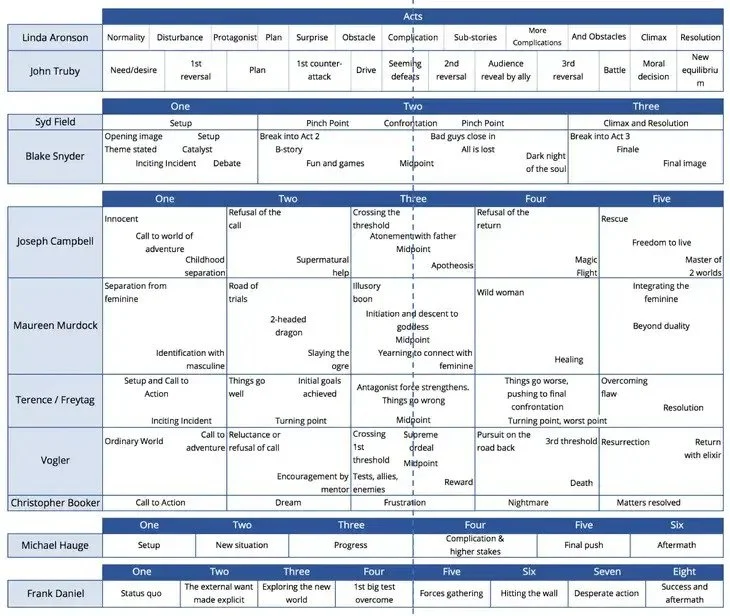
Finding one that works for you is great in the beginning, but the more you write, the more you can intuit the commonalities of structure amongst all the very many options (see image below). Eventually, you'll stop needing to follow [insert framework here] to a T, and start, ya know… just telling your story.
So here are some tips I have for the writers who say they "hate structure" or "don't get it":
Figure out what your hang-up is.
Is it overwhelm of how many options there are and not knowing where to start?
Is it feeling suffocated by rules and wanting to be more free-form with your work?
Is it feeling like there are conflicting “rules” you need to follow and you can’t reconcile all the advice in your head?
Or is it that you’ve done research, but something still isn’t clicking? (this was me)
Treat the problem head-on.
A. If it’s overwhelm, then break this up into bite sized chunks.
Don’t commit to reading Robert McKee’s Story or The Writer’s Journey right away (seriously those books are too long). Start small. A youtube video or a podcast will do. Literally google “how to structure a script-podcast” or whatever and watch the first thing that comes up. Keep it simple.
Once you dip a toe in, you’ll know enough to guide your learning from there. For example, Scriptnotes “How to Write a Movie” or this video on Endings by one of my favorite writers are a great place to start.
Or take the guess work out of the equation and sign up for a class. It doesn’t have to be one of mine (although I am teaching a structure bootcamp) but it can be on Coursera or Edx, Masterclass or Skillshare for online options, NYU has open online courses as well. Or you can go to your local community college or extension school. Classes give you structure (ha), a clear framework to build your skills and lets your brain just focus on absorbing info, and not worrying about what to learn next.
B. If it’s feeling suffocated by rules then repeat this mantra “There are (barely) any rules.”
Any book you read or framework you follow is a path that one dude decided made sense however many years ago. Did those guys invent the medium? No. They don’t make the rules, they just observed commonalities in a vast number of stories and reported their findings in the form of a framework. Guess what? You can do that too.
You don’t have to follow someone else’s rules, make your own! Any of the frameworks, as I said are “training wheels” you don’t have to follow them to the letter if you don’t want to. And what’s more, you can mix and match when you see fit. If you feel suffocated by the number of steps in Save the Cat or the Hero’s Journey, for example, try something soooo simple it gives your room to play, like the basic 5 Act structure, the story spine, the story circle or good ole freytag’s pyramid.
And remember, these are guidelines, not rules. If your Act 1 break/Catalyst falls on page 27 instead of 30 it’s not the end of the world. Remember you know story. It’s in our bones as humans, trust yourself and adapt.
C. The answer to C is similar to B in that you need to remind yourself that there really are no rules.Choose the path that makes sense to you and your story and ignore everyone else. There isn’t one clear correct answer of how to do this, that’s why it’s an art and a craft, not a science.
D. The last one is frustrating because it makes you feel like you are the one doing something wrong (you aren’t.)
There are a few paths here, but my basic advice is it won’t click until it clicks, keep going. I say this because like any piece of writing, the way someone communicates isn’t going to resonate with everyone. Like in high school when your Chemistry teacher seems like they’re speaking another language, but when your friend explains it to you, it makes more sense? You just haven’t met that friend yet. Here’s how to find her:
Shop around. If you’ve only read about the famous frameworks (ie Save the Cat) and it’s not your style, know there are plenty of fish in the sea (not that many fish, but like at least a dozen more fish). You can keep exploring until you find your match. And if that doesn’t interest you you can take the next route.
Don’t rely on books to tell you, do your own analysis of scripts and learn the structure tenets practically. You may just be a kinesthetic learner! You gotta do it to understand it. The more scripts you write, the more feedback you get, the better you’ll understand structure.
Similar to the previous point, but knowing the type of learner you are is helpful. For example I am a very visual person, and it wasn’t until I started mapping out my pilots visually, either with shapes or with color-coded post-its. that things started to make sense to me.
You can mind-map, use graphic organizers or other methods to help break down scripts and see (literally visually SEE) how they work. (If you’d be interested in a graphic organizer template, reply to this email to let me know!)And lastly, yes I’ll say take a class again. This is basically hiring that friend who can explain it to you. A class gives you the opportunity to talk to a professional and work through the roadblocks you’re having. Sometimes an outside perspective from someone who can really break it down for you is what’s needed to make things click.
My advice is to check reviews of the teachers beforehand, though, because not all artists are good teachers, through no fault of their own. But you wanna make sure you can find someone who can really meet you where you are. For this to help, you will want to prioritize courses with live feedback or actual instructor interaction. So things like Masterclass may not be your best bet here.
Hopefully this was helpful! If you have any questions or just want to vent about how much of a ***** structure is, dm me! I wanna hear from you
Open Tabs
Hundreds of celebrities relaunch a McCarthy-era committee to defend free speech (NPR)
Jane Fonda’s Free Speech Warning: ‘They Come for One of Us, They Come for All of Us’ (The Ankler, Live Video)
Carol Burnett Plays On (The New Yorker)
convenience culture is killing our creative impulses (Anna Howard, via Youtube)